




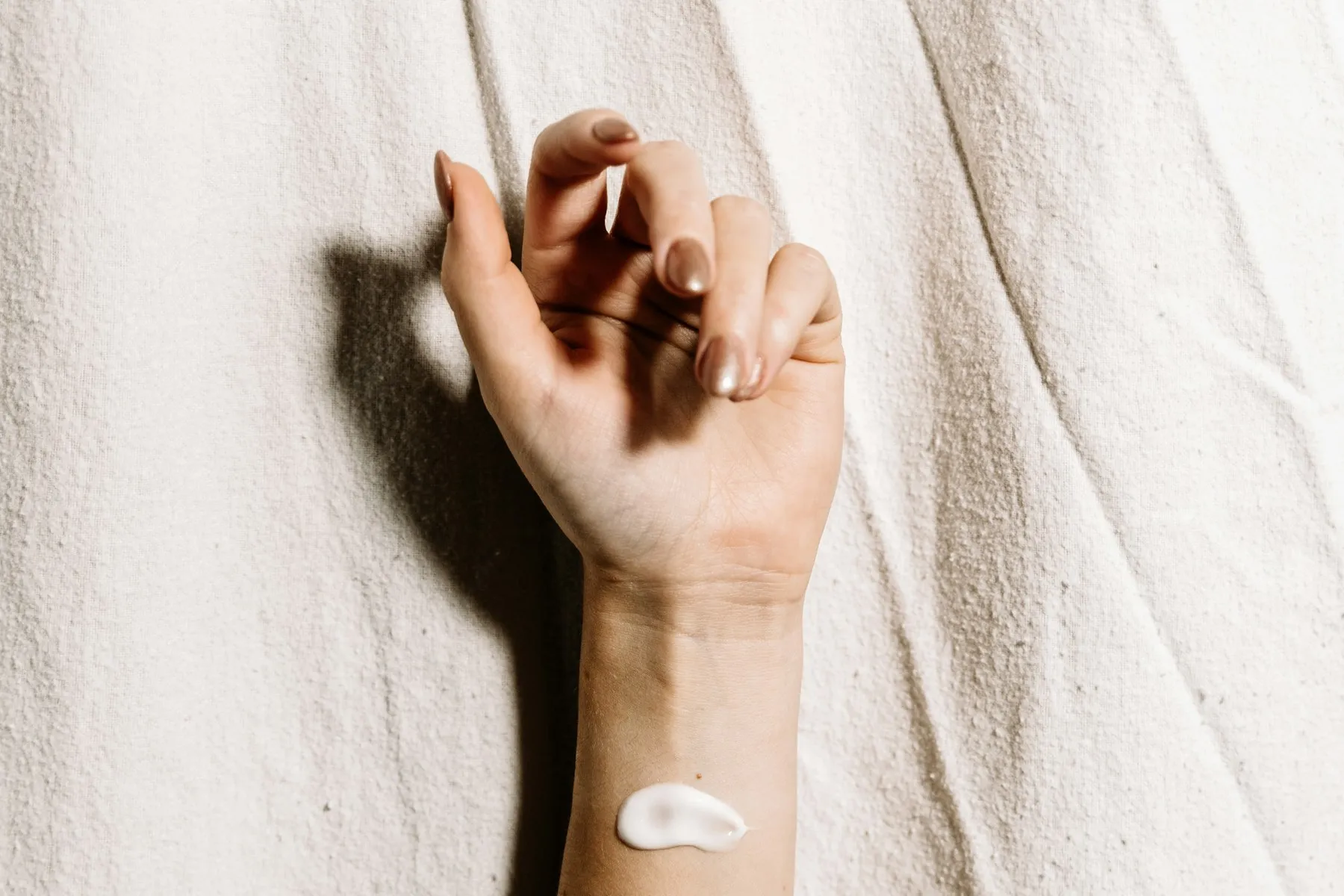
Every product with any potential to irritate carries an instruction to patch test, and the instruction is almost always too vague to follow. So people put a smear on the inside of a wrist, wait for the length of a kettle boil, see nothing, and use it on their face.
That tests for one thing only: immediate contact urticaria, which is rare. It does not test for the two problems people actually have.
The two things worth testing for
Irritant contact dermatitis is dose-dependent and cumulative. It is not an allergy; it is a chemical insult, and it appears after repeated exposure rather than after one. A retinoid, a high-percentage acid or a strong surfactant will pass a single ten-minute test and cause a problem on day nine.
Allergic contact dermatitis is immune-mediated and delayed. A first exposure sensitises silently; the reaction appears on a later exposure, typically twenty-four to seventy-two hours after contact. This is why fragrance allergies seem to arrive out of nowhere with a product someone has used happily for months.
Both of those need days, not minutes. Which is the real reason nobody patch tests properly — the useful protocol is tedious and the product is sitting right there.
The protocol
Choose somewhere thin-skinned and out of the way. The inner forearm near the elbow crease is the standard, and it is a reasonable proxy for facial skin. Behind the ear is better for anything you will use on the face; the skin there is closer in thickness and it is where a reaction shows early.
Apply a small amount, roughly what you would use on that area of your face, and leave it. Do not wash it off.
Repeat once a day, on the same spot, for five days. This is the part everyone skips and it is the part that catches irritant reactions, which need accumulation to show.
Look at it at twenty-four, forty-eight and seventy-two hours after the first application. A delayed allergic reaction usually appears in that window: not a general redness but a defined patch, itchy rather than stinging, sometimes with small bumps, and — the giveaway — sharply bounded at the edge of where you applied it.
What a pass and a fail look like
A pass is nothing, or a faint transient pinkness that has gone within an hour of each application.
A fail is any of: itching that persists, a defined bordered patch, small raised bumps, or a burning that gets worse with each successive day rather than better. Stinging on application that settles in two minutes and does not escalate over five days is usually an irritant threshold rather than an allergy — it means go slower, not never.
The exceptions
Anything containing a hair dye precursor — PPD and its relatives — genuinely needs the full forty-eight hours and genuinely can cause a serious reaction. This is the one patch test with a documented history of people being hospitalised for skipping it, and box dyes say so in small print for good reason.
Anything you have reacted to before, in any form. Cross-reactivity between related fragrance materials and between related preservatives is common enough that a previous reaction is a reason to test the new product for the full five days, not a reason to assume this one is different.
Everything else: five days, behind the ear, and a note on your phone of when you started. It is dull and it is a great deal less dull than three weeks of a face you cannot leave the house with.